shows a woman waking up drinking coffee

A Prayer for Morning Coffee

Estimated reading time: 2 minutes

I found this beautiful “A Liturgy for the Ritual of Morning Coffee” on Pinterest. This morning prayer is from “Every Moment Holy, Volume One,” which you can find here. Douglas Kaine McKelvey is the author.

I had to share this one. It spoke to my needs in the morning. These days I wake up in the cold, dark winter. I am recovering from serious surgery, appalling national news and a traumatic issue in my home church. As my eyes over, I need a place to center my thoughts immediately.

This morning prayer, spoken over a cup of coffee, is a real balm to my soul.

For Morning Prayer and Beyond

We practice the presence of God in the present moment, which we call Christian mindfulness. The first minutes of the day can be fuzzy and even annoying. Cats beg for breakfast. Husbands and children start talking when you can barely open your eyes. You’re tired and woke up against your will. Your schedule for the day will be demanding.

We need guardrails to cause us to look to and welcome the Lord even when we don’t welcome the morning. This prayer is good for that.

McKelvey has three volumes of the “Every Moment Holy” prayers available on everymomentholy.com .and Amazon. He also offers songs, artwork and workbooks. Russell Moore, the editor-in-chief of Christianity Today, praises the worth of McKelvey’s work. He writes that he uses it often when he can’t find the words to walk with Christ in a situation humdrum or difficult.

McKelvey also has an app available at Apple or Android stores. More about that is found here.

His work is a good addition to our resources. You can find more resources for Christian mindfulness that I’ve found useful here.

Do you have other prayers or practices that you use to experience God’s presence in the morning? Please share them in the comments.

Resource: What Would St. Francis do?

“What Would St. Francis Do? A Guide to Simplicity, Compassion and Peace” interested me in multiple ways. Lisa Talarico’s book is the rare examination of St. Francis’ values written by a non-Catholic. Neither does she practice the Christian faith. But she deeply admires Francis of Assisi and wants to incorporate his values into daily life.

This is a quick read that can become a well-used handbook. It presents the case for living out Franciscan ideals in the modern world, with specific ideas for how to do that. Ms. Talarico covers Francis’ ideals in seven components:

  • Simplicity
  • Environment Stewardship
  • Compassion and Social Justice
  • Peacemaking
  • Gratitude and Joy
  • Faith
  • Unity and Inclusion
  • Embracing Change
  • Cultivating Inner Peace

For each value, she provides “a Francis-inspired action plan.” Some steps are similar ideas applied to various target audiences, yet all are good suggestions.

For example, her suggestions for expanding simplicity in your life include:

  • Building a habit of gratitude.
  • Creating giveaway boxes and filling them with those things you don’t need.
  • Scheduling a no-spend week.

I’ve studied and admired St. Francis for decades. I often use material about his life as meditation verses to open contemplative or centering prayer. Still, this book gave me some new ideas that I’m planning to try.

Francis, who believed deeply in the value of poverty, would approve of these steps. The book could be an excellent addition to expand your spiritual practices. It also could be a fine companion for a retreat or a year-long resolution.

For me, the best way to implement the ideas would include deep prayer and the Holy Spirit. Francis would approve. And it certainly would make the changes easier. But, using this book in daily (or weekly) reflection and practice would make anyone, Christian or not, a better person.

The book is available on Amazon. Enjoy it! Other resources for Christian mindfulness are found here.

Resource: “The Cloister Walk”

“The Cloister Walk” by Kathleen Norris is one of the most significant books about contemplative Christianity in recent decades. Published in May 1996, the book is a series of essays about Norris’ explorations of the monastic life. She helps us see the cloistered world of nuns and monks from her own distinct viewpoint.

Norris approaches this world as a married Protestant who can struggle over her faith. Her previous life experiences were varied, from growing up in Hawaii to hanging out with the Warhol folks in New York City. She also has received the Guggenheim “genius” grant.

Kathleen Norris

After she and her husband (both poets) moved to her grandmother’s home in rural South Dakota, she began to be drawn to the contemplative monastic world. She became a Benedictine oblate (or associate) of the Assumption Abbey in North Dakota in 1986.

“The Cloister Walk” functions as a unique record of her experiences and observations, especially when she was in residence twice at the Institute for Ecumenical and Cultural Research at St. John’s Abbey in Collegeville, Minnesota. The book has poems, short essays and stories of saints.

The cover blurb from the Boston Globe called “The Cloister Walk” a “strange and beautiful book. … If read with humility and attention, Kathleen Norris’ book becomes lectio divina or holy reading.”

I took this literally, reading one essay a day. It took months to finish the book. This may not have been the best reading strategy, as I did not enjoy the book as much as I expected. But many others have.

The book spent 23 weeks on the New York Times bestseller list and was a Time notable book of the year. On Goodreads, the book has a 4 out of 5 rating from 9,031 readers.

emotionally healthy woman

Resource: Emotionally Healthy Spirituality

My first five-star book on spirituality of the year is “Emotionally Healthy Spirituality” by Peter Scazzero. Pastors in my church have long recommended this book. Yet it ended up in a pile of books I meant to read for a long time. What a mistake! (Although … I do think the Lord had me read the book when it could help me the most.)

Scazzero, pastor of a large, multiracial church in Queens, New York, teaches how to biblically integrate emotional maturity, the practice of the presence of Jesus, and contemplative spirituality. That’s what Christian mindfulness is all about!

He bases his examination of unhealthy spirituality on the Bowen theory of family dynamics. I spent several years studying this theory and working through the ramifications in my family of origin. Scazzero does a great year explaining it in several chapters.

Breaking old patterns of unhealthy behavior allows us to embrace the presence of God. Scazzero explains how to follow a schedule of prayer, keep Sabbath and write a rule of life. All of this is so helpful to walking in the presence of God in the present moment.

This book helped me to understand why the Lord led me along several paths that I previously thought were wastes of time. Just knowing that makes the book worth it. I think it can help nearly everyone. And I’m not alone. Amazon, with 478 ratings, has the book at 4.5 stars. And Goodreads, with 8,881 ratings, has the book at 4.25 stars.

Other resources for the mindful Christian life are here.

Resource: 30 Days With a Great Spiritual Teacher

Easily among the most significant of my devotional aids is the 30 Days With a Great Spiritual Teacher series, published by Ave Maria Press. I have every volume in the series, and I’ve used them as the first step in morning prayer since 1998.

I rotate the series of the 17 volumes I have. (I’m not sure all of them are still in print.) Each presents 30 days of devotions based on the work of a significant person of faith. You get a morning prayer, a thought to revisit during the day, and an evening prayer.

Two volumes contain work from Francis of Assisi, and another specifically for Lent contains work from several people. My favorites include:

  • “You Shall Not Want,” King David and others who wrote Psalms
  • “Living in the Presence of God,” Brother Lawrence
  • “Set Your Heart Free,” Francis de Sales
  • “Simply Surrender,” Theresa of Lisieux
  • “Let Nothing Disturb You,” Teresa of Avila
  • “Draw Ever Closer,” Henri J.M. Nouwen

Two new volumes, based of the works of Thomas Merton and Augustine of Hippo, are scheduled to come out this year. The books come from a Catholic publishing house, but they are very useful for any Christian. I fully recommend these books for contemplative prayer of any kind. Other resources can be found here.

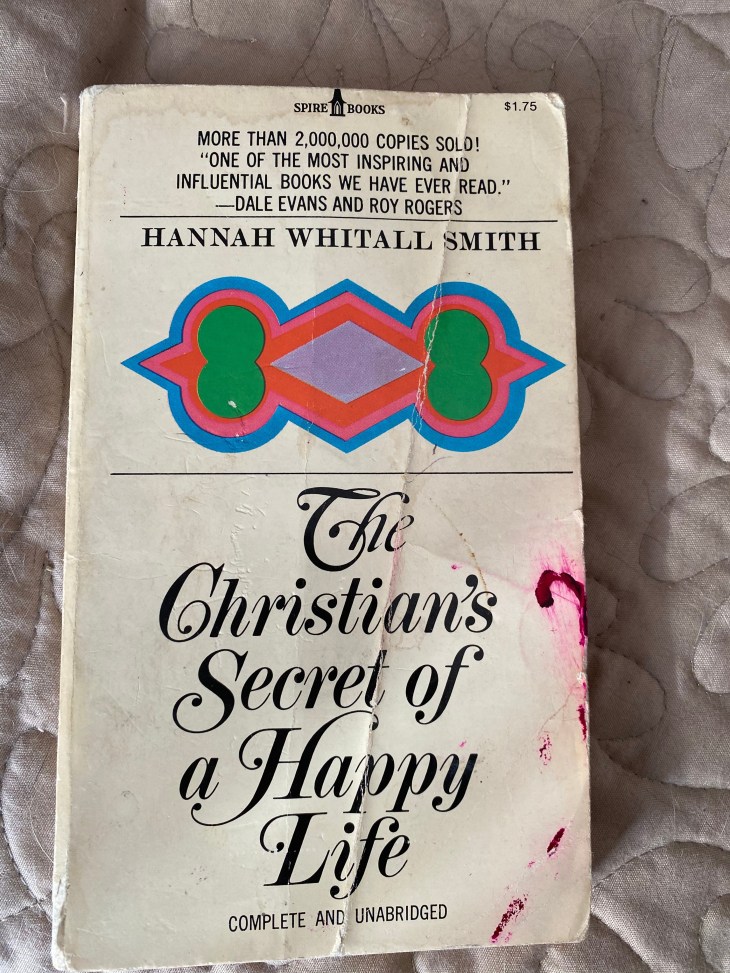
Resource: The Christian’s Secret of a Happy Life

He is our Father, and He loves us, and He knows just what is best, and therefore, of course, His will is the very most blessed thing that can come to us under any circumstances. I do not understand how it is that the eyes of so many Christians have been blinded to this fact. But it really would seem as if God’s own children were more afraid of His will than of anything else in life — his lovely, lovable will, which only means loving-kindnesses and tender mercies, and blessings unspeakable to their souls! I wish only I could show to everyone one the unfathomable sweetness of the will of God.

Hannah Whitall Smith, “The Christian’s Secret of a Happy Life”

Hannah Whitall Smith certainly tried to show everyone the sweetness of God. Her masterpiece, “The Christian’s Secret of a Happy Life,” is one of the most used in my library. I’ve underlined it in almost every color of pen in my many readings.

Smith published her book in 1875. Never out of print, it’s a classic of Christian literature.

Hannah Whitall Smith

Hannah Whitall Smith (1832-1911) was a remarkable woman, especially considering the time in which she lived. Active in the women’s suffrage and temperance movements, Smith was a Quaker and a Christian mystic. (The back cover of my version of the book calls her a “Quaker, rebel, realist.”) In addition to writing books, she preached in the Holiness movement in the United States and the Higher Life movement in the United Kingdom.

She believed in Christian mindfulness, even if she didn’t have that phrase in her vocabulary. She rested in the presence of Jesus as she lived a remarkably active life. She listened for God’s will and she did it. This book tells you how.

My battered and beloved copy of the book. Christian cultural note: Roy Rogers and Dale Evans were the Christian authors recommending it on the cover when I bought it in 1979.

The book remains a relatively easy read because Smith, as a Quaker, used plain speech as she wrote it. It has a 4.5 rating on Amazon with 358 readers ranking it and a 4.3 rating on Goodreads with 1,843 rating it. More recommended books and online resources can be found here.

\

hispanic woman in prayer

Resource: Richard Foster’s Prayer

The best book I’ve ever read about prayer is “Prayer: Finding the Heart’s True Home” by Richard Foster.

Similar in structure to his “Celebration of Discipline,” Foster divides the types of prayers into three categories:

  • Moving inward: Seeking the transformation we need. This includes the prayer of the forsaken, examen, the prayer of tears and formation prayer.
  • Moving upward: Seeking the intimacy we need. It covers the prayer of adoration, prayer of rest, sacramental prayer, unceasing prayer and contemplative prayer.
  • Moving outward: Seeking the ministry we need. Prayers include intercession, petitions, healing prayer and the prayer of suffering.

I’m not alone in treasuring this book, which proves that our prayer lives can always grow. The book won Christianity Today’s Book of the Year and the Evangelical Christian Publishers Association Gold Medallion Book Award. It’s rated 4.6 stars on Amazon.

It’s a book to use as a resource, to ponder, to experiment with. More resources to help in your Christian mindfulness journey are found here.

Resource: Having a Mary Heart in a Martha World

Joanna Weaver published “Having a Mary Heart in a Martha World: Finding God in the Busyness of Life” in 2000, which seems long ago. Yet, her quiet voice on the page is timeless … one of the most influential I’ve heard in my Christian mindfulness walk.

“Having a Mary Heart in a Martha World” remains one of the most re-readable books for women on releasing anxiety and slowing down to sit at Jesus’ feet. She writes:

Jesus’ words to Martha are the words he wants to speak to your heart and mine: “You are worried and upset about many things, but only one thing is needed.” That “one thing” is not found in doing more. It’s found in sitting by his feet.

Throughout the book, Joanna shows that Jesus wants us to choose the one thing: “a joyful life of intimacy with him that flows naturally into loving service.” For women who feel that they are not enough, it is a soothing balm.

On Goodreads, the book has a rating of 4.2 out of 5 stars with nearly 16,000 reviews. The copy of the book I have includes a study guide for individual or group use. To taste the tone of the book, here’s another gift: a version of Psalm 23 from Japan.

The Lord is my pace setter … I shall not rush.

He makes me stop for quiet intervals.

He provides me with images of stillness which restore my serenity.

He leads me in the way of efficiency through calmness of mind and his guidance is peace.

Even though I have a great many things to accomplish each day, I will not fret, for his presence is here.

His timelessness, his all importance will keep me in balance.

He prepares refreshment and renewal in the midst of my activity by anointing my mind with his oils of tranquility.

My cup of joyous energy overflows.

Truly harmony and effectiveness shall be the fruits of my hours for I shall walk in the Pace of the Lord and dwell in his house forever.

Additional resources for Christian mindfulness are listed here.

Resource: Jesus Calling

“Jesus Calling” and the other works of Sarah Young are among the most useful resources I have.

We use readings from these books as devotionals for our support groups, where we serve individuals diagnosed with severe mental illness and their families.

I also use the books as part of my daily prayer round in lectio divina. I read the passage, pause to ponder it, pray parts of it out loud and then meditate on it. I rotate using Jesus Calling, Dear Jesus, Jesus Always, Jesus Today and Jesus Lives. The Jesus Calling app is one of the most used items on my phone.

Sarah Young began to write her books of devotions based on her own daily quiet time, which includes journaling. The retired Presbyterian missionary has an extraordinary ability to help people connect to the Biblical truths in a warm and loving manner.

More than 30 million of her books have been sold. Although she is biblically conservative in her faith and reformed in her doctrine, I’ve never met a Christian … liberal or conservative … who objects to her work. It is so Bible-based as to be universal.

Please enjoy some time with the Lord under her guidance.

Other resources that are useful to me are located here.

silhouette photo of man leaning on heart shaped tree

Resource: Life of the Beloved

This beautiful book — “Life of the Beloved: Spiritual Living in a Secular World” — began when a non-religious friend asked one of the late 20th century’s most renowned religious men to explain spiritual life.

Henri J.M. Nouwen responded with the manuscript for “Life of the Beloved.” Nouwen avoided spiritual “Christian-ese” and theology. He told his friend about how much God loved him and what knowledge of that love does to a person.

Nouwen’s friend still didn’t get it. At first, Nouwen thought he had failed. But the response among others who read the manuscript was overwhelming positive.

Considered one of the greatest spiritual writers of the 20th century, Nouwen was a Catholic religious who taught at Harvard, Yale and Notre Dame. He spent 10 years living and serving in a community of the developmentally disabled called L’Arche Daybreak in Toronto.

Just flipping through the book gives you gems of wisdom:

“The world is only evil when you are its slave.”

“The problem of modern living is that we are too busy to notice that we are being blessed.”

“The real question is not ‘What can we offer each other?’ but ‘What can we be for each other?’ “

“Life of the Beloved” is a masterwork, well worth your time.